
Heat Continues into August
Last month focused on heat. More specifically, on how flying in hot ambient temperatures can affect our human performance as well as the performance of our airplanes. Also, we added three related videos to our Essential Vectors Series. Find them plus a "fan favorite" in our Videos Section. (Note: Scroll down to the Essential Vectors section.) Plus, check out our Old Pilot Tips video titled "Hydration." Check it out here.
Highly Recommended Issue of "NASA Callback"
A very appropriate issue of "NASA Callback" has been released. "Expect the Unexpected" applies to all segments of aviation. Check out Issue 557 here.
Recommended Course: "Avoiding the Summer Flight "Gotchas"
Summer flying is great but it also comes with several hazards. Be safer and earn Wings credit too! Click here to visit the course provided free courtesy of Avemco Insurance.
Book Your Free Virtual Safety Seminar
Whether your pilot group meets all together, virtually, or hybrid, you can schedule a program, valid for FAA Wings credit, free-of-charge courtesy of Avemco Insurance. Programs are live with Gene Benson and always include a Q&A session at the end. Click here to download our presentation catalog. For more info or to schedule, contact gene@genebenson.com.


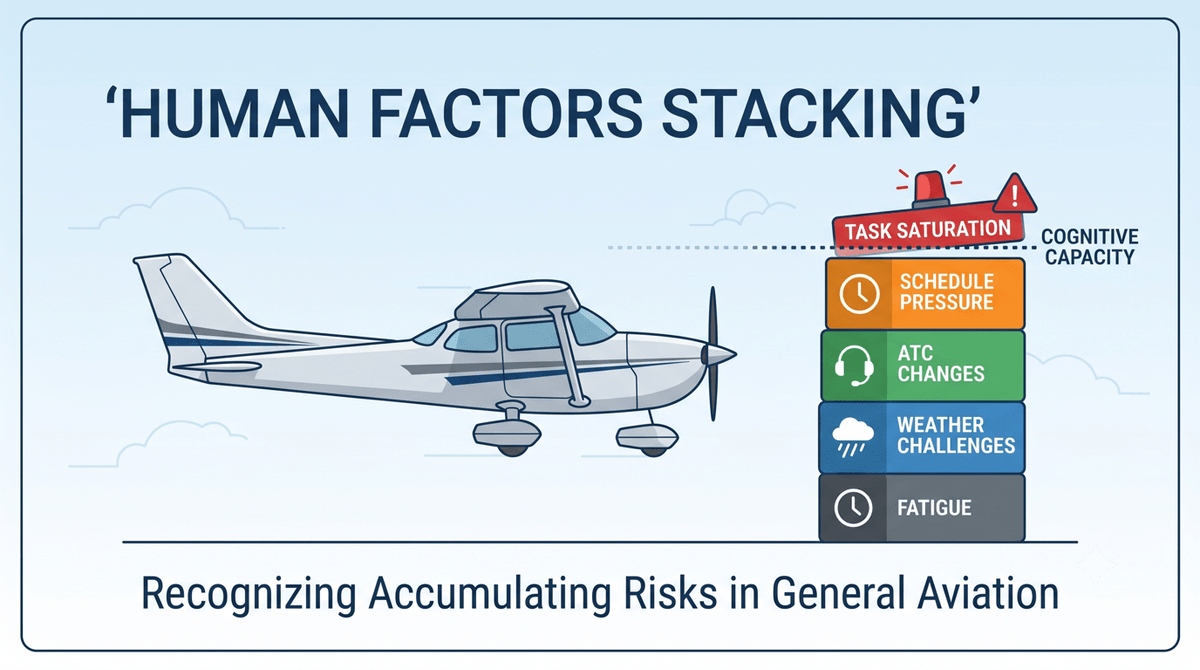
Human Factors Stacking: When Small Threats Become a Big Problem
Have you ever noticed how serious incidents rarely come from a single mistake? The Human Factors Stacking briefing reminds us that risk often builds quietly. A little fatigue, some weather challenges, a late ATC change, and a bit of schedule pressure may seem manageable on their own. Together, they can overwhelm a crew’s mental bandwidth.
What Exactly Is Human Factors Stacking?
Human Factors Stacking describes the accumulation of several sub-critical stressors that collectively exceed a pilot’s cognitive capacity. The key insight is that the effect is non-linear. As threats interact, workload grows faster than expected, making decision-making, monitoring, and communication more difficult.
Why Cognitive Reserve Matters
Under normal conditions, flight crews maintain a healthy cognitive reserve that supports anomaly detection and sound decision-making. Each new challenge consumes a portion of that reserve. When multiple stressors arrive simultaneously, the reserve shrinks rapidly and task saturation can occur.
The Three Most Common Stack Builders
Fatigue—especially during the Window of Circadian Low (02:00–06:00)—reduces processing capacity before operational demands are even added. Plan Continuation Bias, often called get-there-itis, encourages pilots to stick with the original plan despite changing conditions. Operational and time pressure can compress decision-making and discourage pilots from taking a needed pause.
The Multiplier Effect
We must realize that human factors do not simply add together. Fatigue can weaken defenses against continuation bias. Add time pressure, deteriorating weather and a minor malfunction and situational awareness may begin to break down. In other words, 1 + 1 can sometimes feel like 5.
Scenario Spotlight
Imagine a pilot flying a non-precision approach at 11:30 PM local time. Weather is marginal, ATC issues a last-minute reroute, an automation discrepancy appears, and internal pressure exists to complete the flight. Individually manageable, these threats can stack until cognitive workload exceeds safe limits.
Warning Signs
Watch for repetitive radio calls, missed checklist items, task fixation, rushing through procedures, or the feeling of being behind the aircraft. These are often early indicators that the stack is growing.
Your Best Defense: The Operational Pause
One of the most powerful tools available is simply creating time. Requesting a hold, conducting a go-around, or otherwise slowing the pace of operations can act as a cognitive circuit breaker. This pause helps pilots restore situational awareness and develop a lower-risk plan.
Final Approach
The lesson is simple: accidents are rarely caused by a single threat. By recognizing stacked risks early, verbalizing active threats, and deliberately creating time, crews can protect cognitive capacity and maintain safer operations.
Want to learn more about cognitive science and how it applies to the general aviation pilot? Check out our "Squawking Human" feature!

Note: this month's topic and blog title were inspired by a recent edition of "NASA Callback" as was referenced in the July 2026 issue of "Vectors."
Expect the Unexpected!
As pilots, we spend a lot of time training for things we know might happen—engine failures, changing weather, and system malfunctions. But in the real world, problems rarely show up exactly the way they do in training.
The engine doesn’t completely fail—it just starts running rough.
The weather doesn’t gradually deteriorate—it changes unexpectedly.
The problem isn’t obvious—it’s unclear and difficult to diagnose.
These are the situations where risk often begins to build.
What makes them challenging isn’t always the event itself. It’s the way they disrupt our expectations. When reality doesn’t match the picture we had in our heads, it’s easy to hesitate, focus on the wrong issue, or misunderstand what’s actually happening.
Preparing for the unexpected is about developing our ability to adapt.
There are a few ways we can strengthen that skill.
Begin by mixing up training scenarios instead of practicing the same situations repeatedly. Challenge the first conclusion by asking, What else could be causing this? Resolve to manage attention carefully—flying the airplane first and treating all other tasks as secondary. And as I have written many times before, establish decision points ahead of time, such as when we’ll go around or when to divert to an alternate airport.
Most importantly, we need to recognize that not every problem will make immediate sense. We don’t need a perfect diagnosis to make a good decision. Keeping the aircraft stable, preserving our options, and taking action early are often far more important.
In aviation, the unexpected isn’t the exception—it’s part of the job. When we accept that reality, we’re better prepared to handle whatever comes next.
Remember that safety doesn’t come from predicting every possible scenario. It comes from being ready when the prediction is wrong.

Accidents discussed in this section are presented in the hope that pilots can learn from the misfortune of others and perhaps avoid an accident. It is easy to read an accident report and dismiss the cause as carelessness or as a dumb mistake. But let's remember that the accident pilot did not get up in the morning and say, "Gee, I think I'll go have an accident today." Nearly all pilots believe that they are safe. Honest introspection frequently reveals that on some occasion, we might have traveled down that same accident path.
This accident happened in August 2025 in Wyoming. The aircraft involved was an Aviat A1 which was substantially damaged. The 66-year-old commercial/CFI reported having an estimated 3442 hours total flight time including 250 hours in this make and model. He was current regarding a flight review and an FAA Class 2 Medical Certificate. The pilot and passenger both received minor injuries.
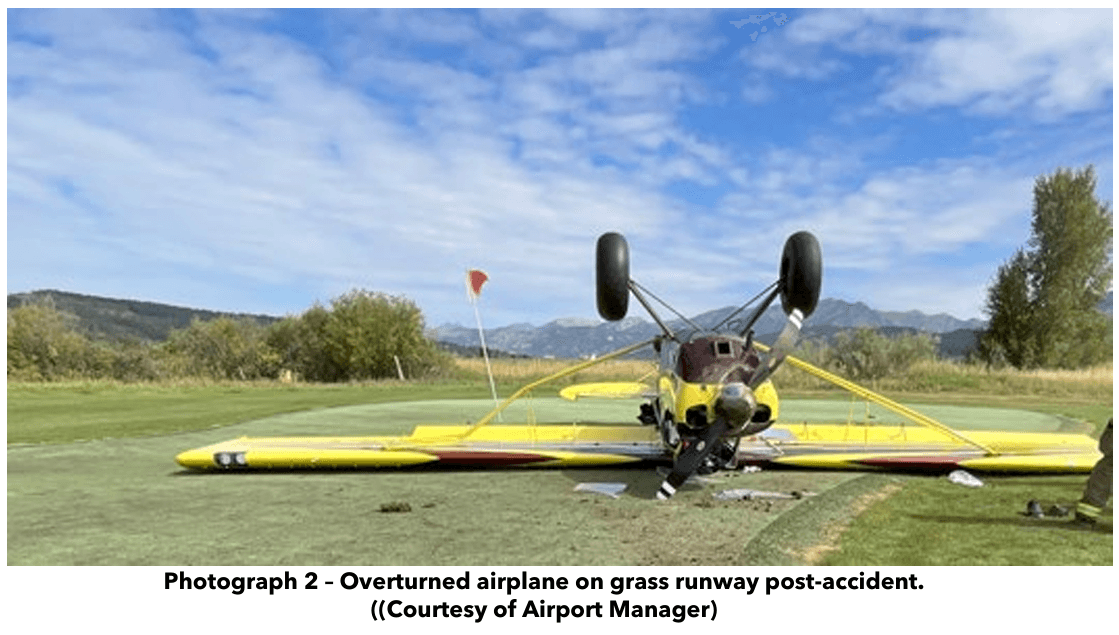
NTSB Supplied Photo
The NTSB accident report begins: "The pilot was departing from a private grass airstrip when an animal ran onto the runway. In an attempt to avoid a collision, the pilot applied abrupt back pressure on the control yoke, and the airplane lifted off before reaching a sufficient airspeed for sustained flight. The airplane settled back onto the runway and bounced. With limited runway remaining, the pilot aborted the takeoff and applied heavy braking, and the airplane subsequently nosed over, resulting in substantial damage to the rudder and vertical stabilizer." In the NTSB Form 6120 filed by the pilot, he stated that the animal was likely a coyote or a dog.
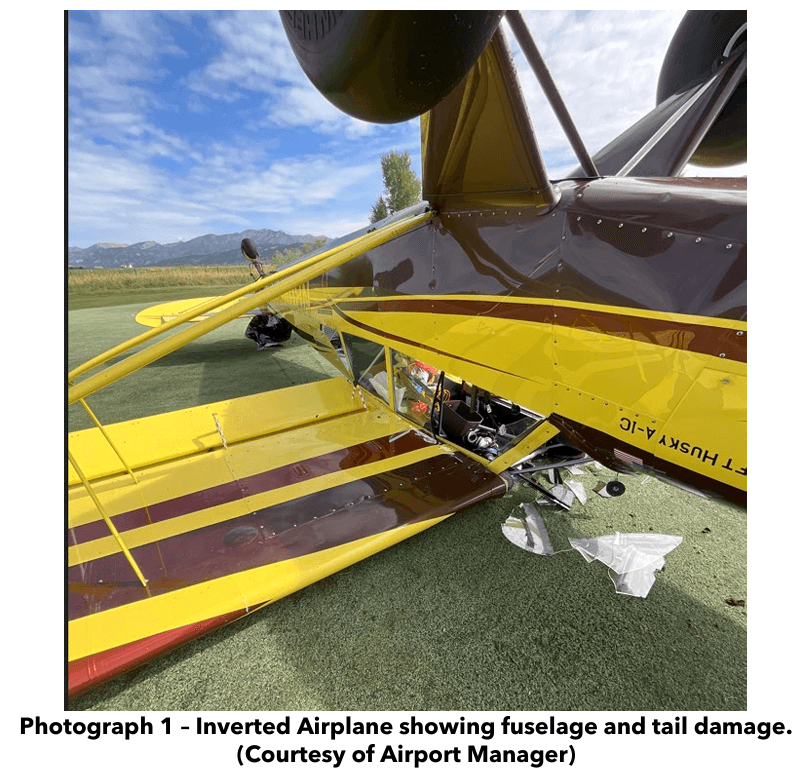
NTSB Photo
The NTSB probable cause states: "The pilot’s premature rotation at insufficient airspeed during takeoff to avoid an unexpected animal on the runway, which resulted in a loss of control and subsequent nose-over during the aborted takeoff. Contributing to the accident was the pilot’s excessive brake application."
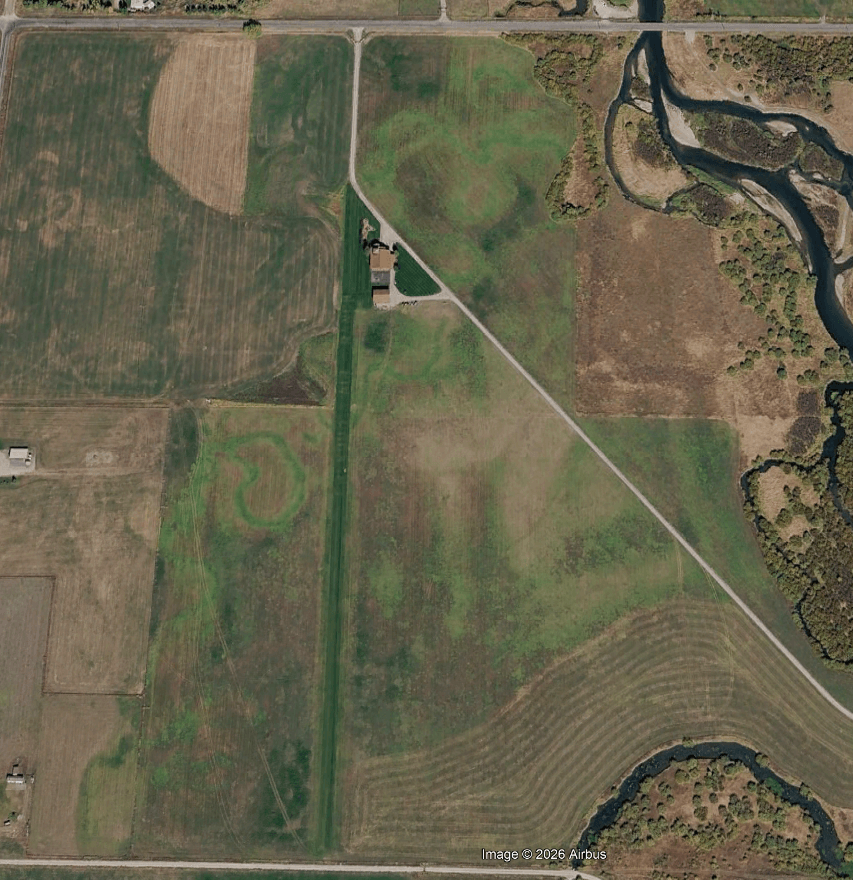
Double L Ranch Airport (Google Earth)
Having an animal dart out onto the runway during the takeoff roll certainly qualifies as an unexpected event. It is arguably comparable to having an animal run out in front of the car as we drive down a highway. Assuming the animal is not within safe stopping distance, what is the best action to take? No one wants to hit an animal, whether domestic or wild. But as pilots, we must adhere to two covenants, First, our own and our passengers' safety is our primary concern. Second, we must fly the airplane until it is stopped, no matter what.
This required what we call urgent decision making. In fact, it required a series of urgent decisions. When the animal was first sighted, there were just a few seconds during which a course of action had to be decided and executed. At least three options were available: close the throttle and accept a collision with the animal, close the throttle and attempt to turn away from the animal, or attempt to become airborne and clear the animal. The first option may have been viable but would have resulted in death or injury to the animal and likely damage to the airplane with minimal risk of injury to the pilot and passenger, given that the animal was the size of a coyote or a dog. The second option may or may not have avoided a collision with the animal but would have undoubtedly resulted in a high-seed ground loop substantially damaging the airplane and causing an increased likelihood of serious injury to the occupants. The final option, the one chosen by the pilot, allowed the airplane to clear the animal but then came back down and made contact with the runway resulting in an apparently significant bounce and another runway contact. Now a second urgent decision was required. Should another takeoff be attempted or should the pilot stay on the ground and attempt to stop? The pilot, aware of a berm and creek at the end of the runway made the decision to brake. Upon realizing that he probably could not stop completely before hitting the berm, he braked hard, probably knowing that it would result in a nose-over.
Did the pilot make the right decision? In my opinion, this pilot took what his experience and training told him was the best option, and he continued to fly the airplane until it stopped. At the end of the day, that is what counts and that is what defines a good pilot.
Click here to download the accident report from the NTSB website.
Accidents discussed in this section are presented in the hope that pilots can learn from the misfortune of others and perhaps avoid an accident. It is easy to read an accident report and dismiss the cause as carelessness or as a dumb mistake. But let's remember that the accident pilot did not get up in the morning and say, "Gee, I think I'll go have an accident today." Nearly all pilots believe that they are safe. Honest introspection frequently reveals that on some occasion, we might have traveled down that same accident path.
This crash involved a Beech A36 and happened in Alabama in August 2024. The 66-year-old 1444-hour private pilot and his two passengers escaped uninjured but the airplane was substantially damaged. The NTSB accident report begins as follows: "The pilot reported that, during the initial climb following a takeoff from runway 20, the airplane encountered an abrupt, unanticipated wind shift. The airplane was unable to gain altitude during the initial climb and the pilot elected to land the airplane on the remaining runway. During the landing, the airplane touched down with its landing gear retracted, overran the departure end of the runway, and came to rest in a grassy area. The airplane sustained substantial damage to the fuselage during the accident."
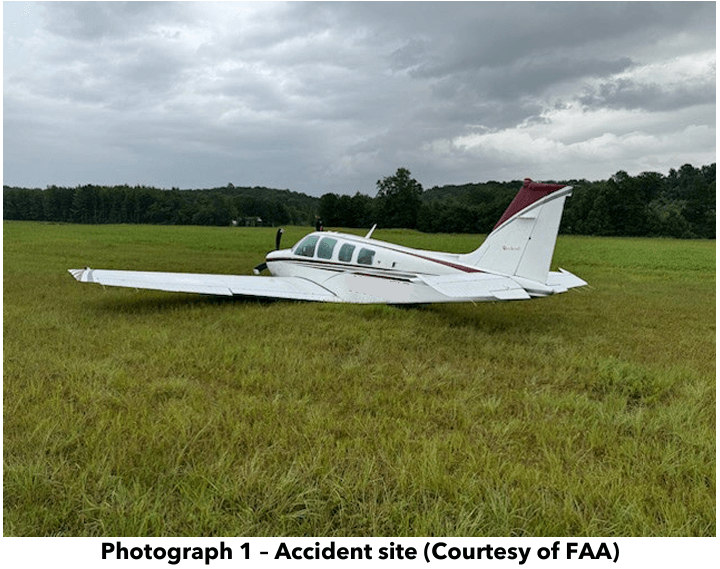
NTSB Photo
The NTSB report continues: "The surface weather observation reported at the airport about 5 minutes before the accident included wind from 200° at 12 knots, gusting to 18 knots, with thunderstorms noted in the vicinity and a remark of distant lightning from the west to northeast quadrants. The pilot stated that he was aware of the wind conditions and that during taxi he noted that the windsock validated the direction/speed. He also reported that it started to rain as he lined up on the runway for the takeoff. The weather conditions reported about 15 minutes after the accident included variable wind direction at a velocity of 5 knots with gusts to 28 knots, a visibility of ½ statute mile in heavy rain and thunderstorms, with lighting present in all quadrants. These weather observations surrounding the accident time were indicative of changing weather conditions associated with convective weather activity, which could include sudden wind shifts."
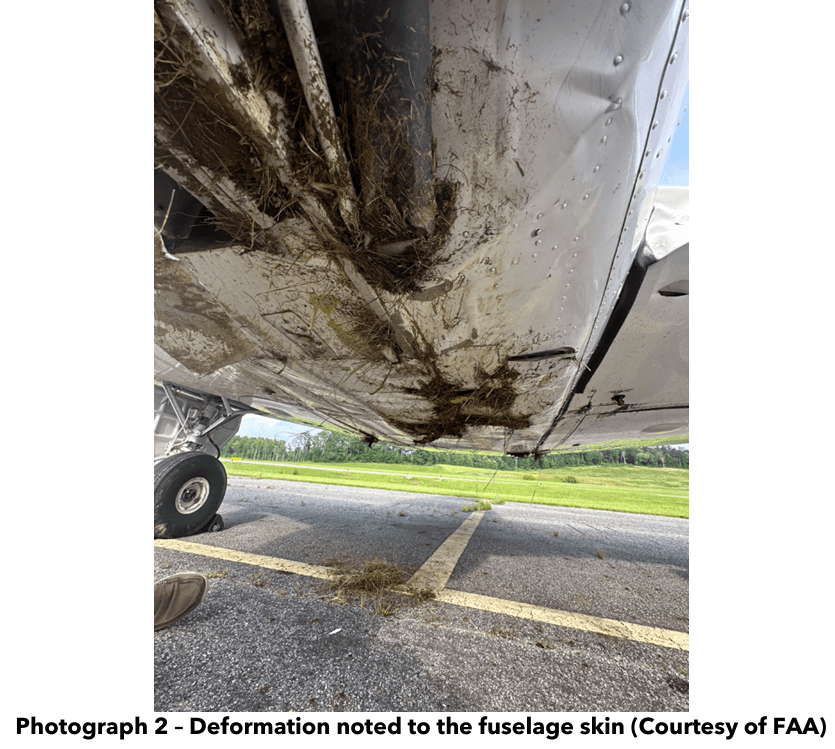
NTSB Supplied Photo
The NTSB probable cause states: "The pilot’s decision to depart in an area of developing convective weather, which resulted in an unanticipated wind shift during the initial climb after takeoff, a loss of climb performance, and the subsequent forced landing."
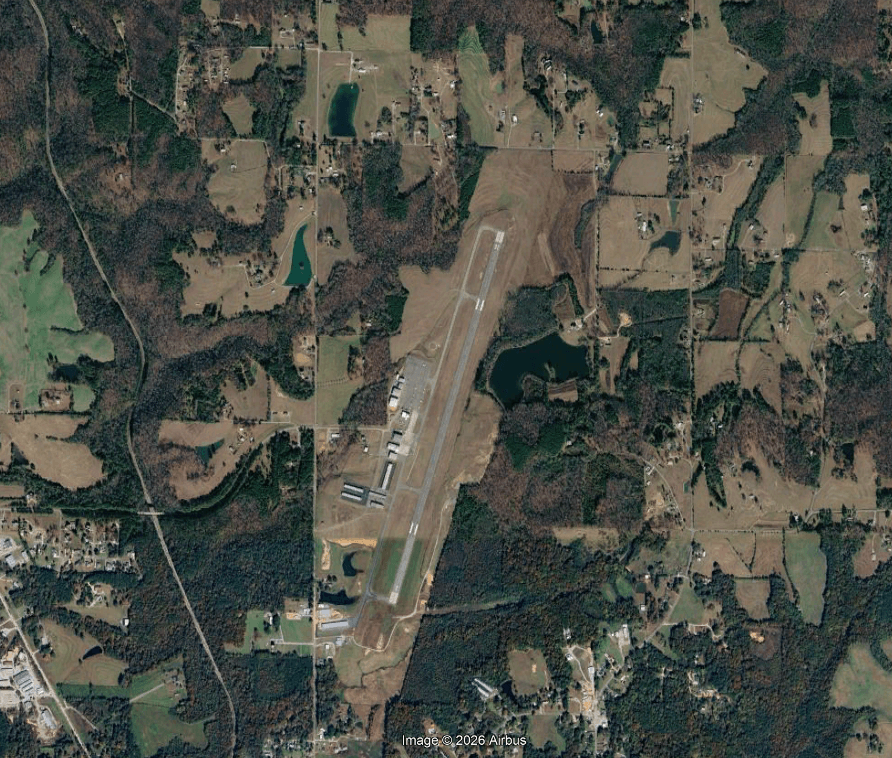
Cullman Regional airport (Google Earth)
Again, this pilot did not expect to be affected by the approaching weather and had to make an urgent decision. In his NTSB 6120 report he stated that he was convinced that the airplane would not continue to fly and would not be able to outclimb the terrain, so he made the decision to set down on the remaining runway. He had just a few seconds to make the decision to continue or to land.
When an accident happens and no one is injured, it is difficult to fault the pilot's urgent decision. However, the pilot's decision to begin the takeoff roll with thunderstorms in such close proximity was flawed. The tried-and-true rule to keep a minimum of 20 miles between thunderstorms and your airplane should not be ignored. In his defense, it is difficult to know the distance and intensity of the thunderstorm. Our humanness exerts continuation bias and tells us to go. Our optimism bias tells us that it will be fine. Most pilots, including myself, have hurried a departure to avoid approaching weather. It is just not a good idea when the approaching weather includes thunderstorms.
Click here to download the accident report from the NTSB website.
Accidents discussed in this section are presented in the hope that pilots can learn from the misfortune of others and perhaps avoid an accident. It is easy to read an accident report and dismiss the cause as carelessness or as a dumb mistake. But let's remember that the accident pilot did not get up in the morning and say, "Gee, I think I'll go have an accident today." Nearly all pilots believe that they are safe. Honest introspection frequently reveals that on some occasion, we might have traveled down that same accident path.
This crash occurred in Arizona in November 2025. There were no injuries, but the Cessna 150 was substantially damaged. The 67-year-old private pilot reported having an estimated 510 total flight hours, including 477 in this make and model. He had a current flight review and was operating under BasicMed rules.
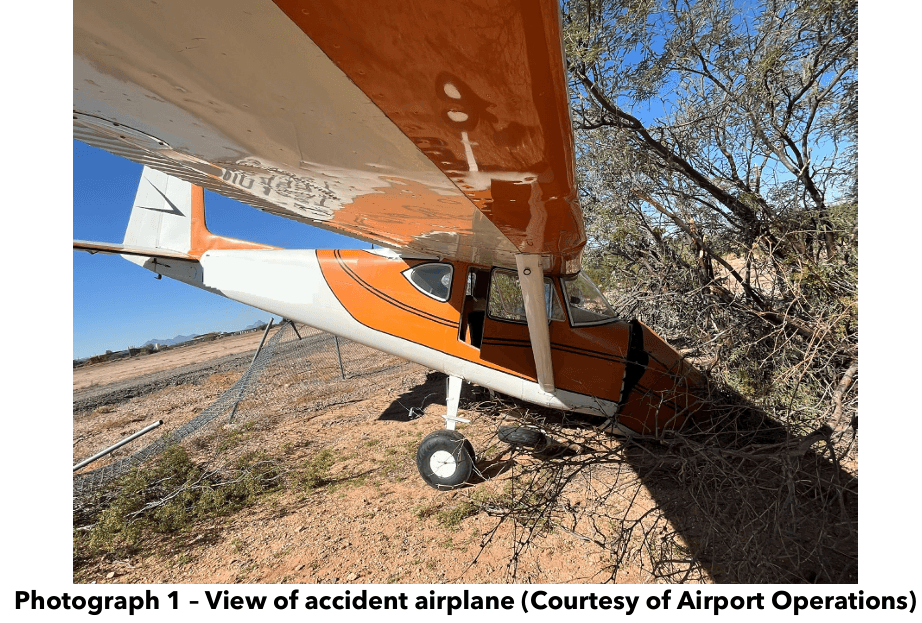
NTSB Supplied Photo
The NTSB report includes the following: "The pilot reported that after he had taxied to the runup area, he decided to shut down the engine and verify the fuel levels. Afterwards, he attempted to restart the engine and found that the battery was dead. He exited the airplane, chocked the left main landing gear, set the throttle and magneto switch before he hand propped the engine. . . After the engine started, he removed the chock from the left main landing gear and attempted to re-enter the airplane. As the pilot re-entered the airplane, the throttle lock loosened, and the airplane accelerated forward without the pilot in the airplane. The unoccupied airplane subsequently impacted an airport fence, which resulted in substantial damage to the engine mount."
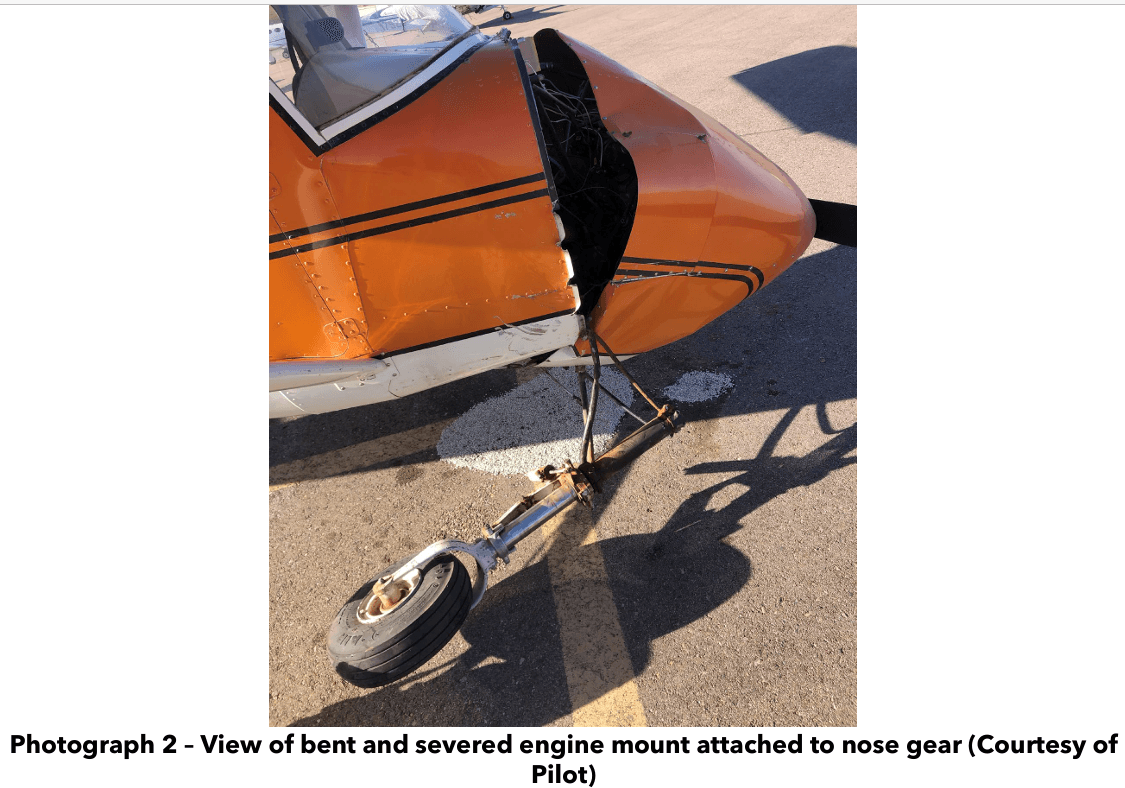
NTSB Supplied Photo
The NTSB probable cause states: "The pilot’s improper starting procedure which resulted in the airplane’s unexpected movement and subsequent impact with an airport fence."
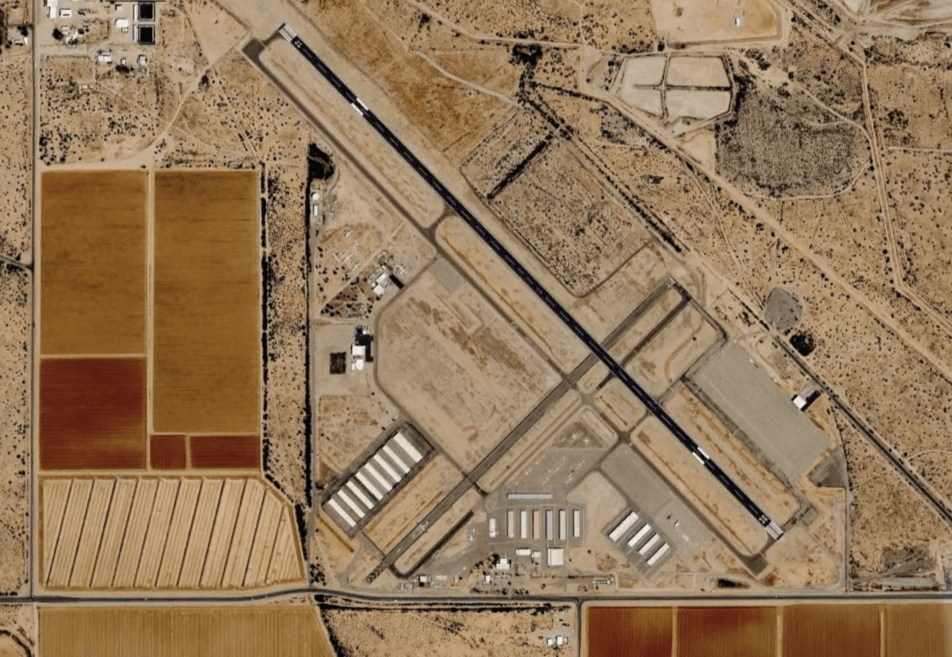
Marana Regional Airport (Google Earth)
The unexpected event here was the inadvertent application of engine power as the pilot was entering the airplane. The pilot is fortunate that the airplane "went forwards without him" rather than dragging him along to the accident site.
We cannot make judgement as to what actions, if any, the pilot might have taken immediately following the unexpected of the increase in engine power. Obviously, killing the ignition or pulling the throttle back to idle would have been ideal but we must assume that neither could be accomplished.
The lesson learned here is that hand propping without a competent person at the controls may not end well. Hand propping is not a solo endeavor. Even if the airplane is tied down or chocked, the solo pilot must free it before getting in. As we see here, bad things can happen in the brief time between freeing the airplane from ropes or chocks and being correctly positioned at the controls.
Click here to download the accident report from the NTSB website.
Not subscribed to Vectors for Safety yet? Click here to subscribe for free!